 Danish text: Hanne Hauerslev
Photo: Tina Enghoff
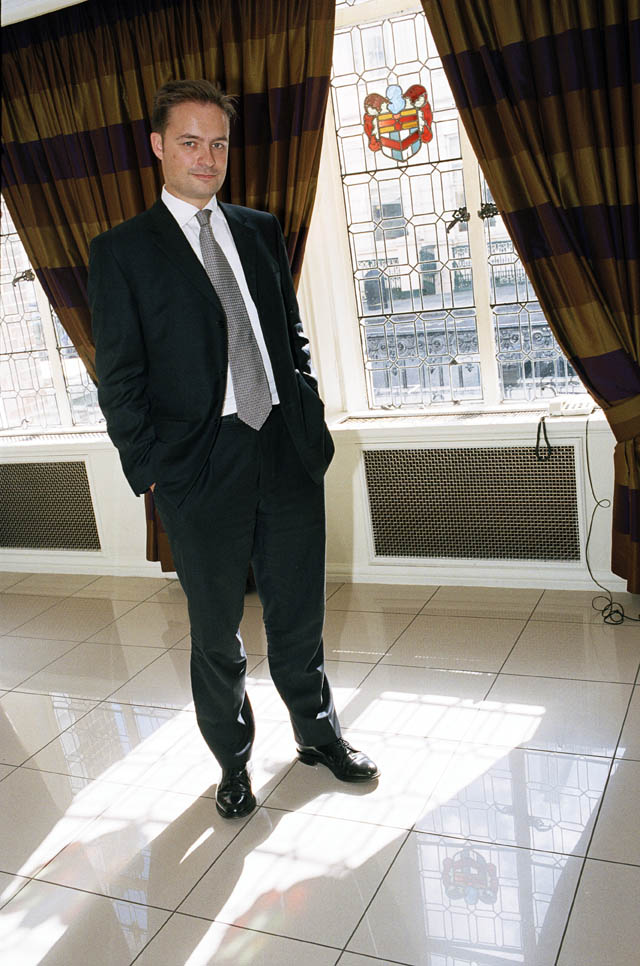
Behind the royal Buckingham Palace lies a small quaint street with white English terraced houses. Jacqueline Kennedy’s sister, Caroline Lee Radziwill, lived here in number 4 for 30 years. This was where John F. Kennedy stayed when he came to London and he used to dine in the room decorated with leather tapestry.
Both the dining room and the sitting room with the floral curtains remain exactly the same as they were then. But today the Anglo-Danish law firm Corren Troen inhabit these rooms. Initially, about three years ago, the firm rented one single room. Now the 20 employees inhabit most of the building and also have a team in Copenhagen.
One of the lawyers, 36-year-old Mads Birkeland, has been a partner since he became a solicitor in 2004. They were a team of five from Osborne Clarke who decided to set up their own firm. In their opinion, the client base was there. 50,000 Danes live in London and several Danish companies would like to get in touch with the English market.
– We specialise in Anglo-Danish law. When a Danish company wishes to take over an English company it is often desired that the deal be done in accordance with its own traditions. The English party feels the same way. However, the two legal frameworks must be adjusted to one another and this is our specialty. The law differs in lots of ways. For instance, the rules regulating when an offer can be retracted are very different – and rules based on EU directives may have been implemented in different ways, which becomes significant when deals are being made across borders, Mads Birkeland explains.
After four years of working as a lawyer at Danske Bank in Copenhagen and six years of working in England he feels at home in the legal systems of both countries. But it has been a hard journey.
– You are somewhat disadvantaged when you first arrive. Your English is poorer, your knowledge of English law is limited, you are not acquainted with certain terms and expressions commonly used in the business and you have no network. At times it feels like you are starting from scratch completely, says Mads Birkeland, who believes it takes about a year to crack the linguistic code.
– You may as well accept that it will never be completely perfect – and I still have days when I feel caught between two languages and cannot find the right words in either Danish or English.
Only an hour and a half to Denmark
He is very well qualified. A Master of Law Degree from University of Copenhagen, a Business and Finance Degree from the Copenhagen Business School and an MBA from the University in Bath.
– I actually chose to do an MBA to improve my English. I did not think it was adequate after many years of studying in Danish. I just wanted to go to Bath for a year, but then I met my girlfriend, Euri, who comes from South Korea.
When I had completed my MBA it was natural for us to stay in London, a city that accommodates many nationalities. I was then employed at the international law firm Osborne Clarke where I worked as a trainee solicitor under the Danish lawyer Per Troen who has worked as a lawyer in London since 1984.
– The international environment suits my girlfriend and me. Our mutual language is English and we have gained many friends from all over the world who have also chosen to live in London. Furthermore, it only takes an hour and a half to get to Denmark where I go as often as I can. I still have my best friends and my base there – even though we have now bought a flat by the Thames in East London and both feel well at home.
The most important things you carry with you are legal methodology and plenty of pluck, Mads Birkeland states.
– In order to obtain the best possible knowledge of English law I chose to study the “Postgraduate Diploma in Law” on an equal footing with those English students who wish to convert their other university degrees to law degrees. You can complete this diploma by studying full time for a year. I studied part time in the evenings. It was hard work but also incredibly rewarding because you gain an understanding of the foundations within the English legal system which makes it possible to build a bridge between the
two legal systems.
Before he could call himself a solicitor, Mads Birkeland also had to pass two out of the four subjects that make up the Law Society’s “Qualified Lawyers Transfer Test”. As a Danish “Advokat” you must pass the subjects “Property”,
“Principles of Common Law”, “Litigation” and “Professional Conduct and Accounts” before you can call yourself a solicitor and have the right to establish yourself as such in England.
First there is small talk
Bit by bit the English culture becomes ingrained in you.
– The English can be very different from the Danes. We are used to approach matters in a very direct way when we do business with each other. The English find this incredibly primitive. They like to spend the main part of a first meeting getting to know their potential business partners. You have to be able to small talk about the weather, sports, politics and the perpetual traffic problems explains Mads Birkeland, who taught himself the rules of cricket purely so that he could contribute in conversations about the English national sport.
– Many Englishmen feel it is rather cold and perhaps unpleasant to discuss business, especially if an offer is to be rejected. We had a client who thought that a business meeting had exceeded all expectations – he had even been invited to the home of the English business partner in the evening. So the Dane went back to Denmark thinking that the deal was more or less settled. Therefore it came as a great disappointment when the contract never came to anything. But this is typically English. They wrap up the unpleasant message in politeness; it is a way of saying: “We think you are a nice guy, but we do not wish to do business with you – therefore we’ll give you dinner to show you there are no hard feelings”.
Another classic example is turning up to a meeting dressed in a very nice outfit according to Danish customs: Polo T-shirt, corduroy trousers and a nice jacket. Of course, the English participants are dressed in impeccable dark suits.
– Afterwards the Dane rushes into town and spends a fortune on a dark suit so he can dress appropriately for the dinner in the evening….. where the English guys are dressed in jumpers and check jackets. It is not very amusing. And it has happened on
occasion that we have sent a client out shopping for a suit to prevent such a situation from occurring.
Work and leisure merge into one In London many important decisions are made in sociable settings over lunch, at
dinner parties or even down the pub.
– In the old days pub meetings were more prevalent than they are today, but it is necessary to spend quite some time socialising in for example the Danish Club, at charity events or at events arranged by the Danish-UK Chamber of Commerce.
Networking is extremely important and I meet lots of nice people in this way. In this way work and leisure easily become inter-changeable. And I have the opportunity to talk to other Danes. It is rather nice to be able to express yourself in detail about your experiences in England – and just to laugh about the same things, says Mads Birkeland.
He does not rule out that he may return to Denmark in the long run. For instance, having children in London does not appeal to him. The acts of terrorism have also made a big impression.
– Normally I arrive at work at 8 o’clock, but on the very day of 7 July I arrived at 9 o’clock because I was waiting at home for some plumber to arrive. I arrived on the underground at 8.45 am. The bomb exploded at 8.51 am. A colleague from the office had just walked down a side road when the bus in Tavistock Square exploded behind her. So yes – it was really close and even when we speak about it now, it sends shivers down my spine. That day we were all in shock. But now I try not to think about terrorism. It will definitely not be terrorism that decides whether or not I’m going back to Denmark.